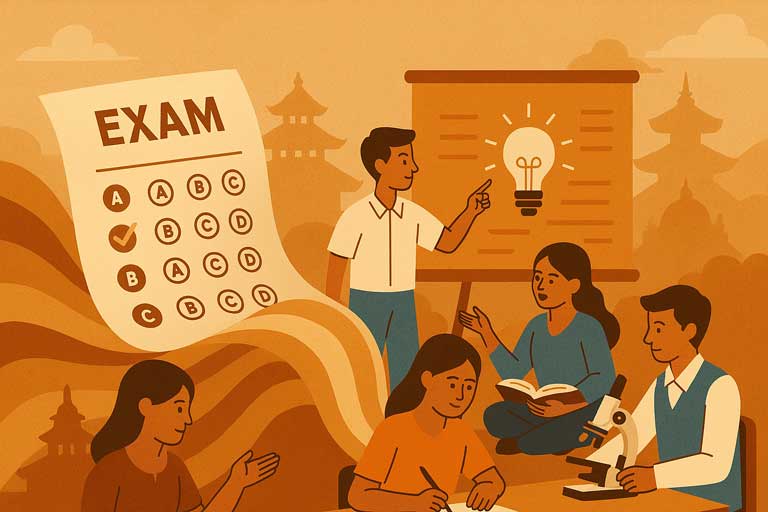

The discourse surrounding education in Nepal has reached a critical juncture with the government contemplating the removal of the Secondary Education Examination (SEE). The SEE, formerly known as the School Leaving Certificate (SLC), serves as a national-level examination administered by the National Examination Board (NEB).
From “Iron Gate” to Stepping Stone: The History of the SEE
SLC: A Legacy of Rana Rule
The history of national-level examinations in Nepal traces back to 1934 (1990 B.S.) with the introduction of the School Leaving Certificate (SLC) examination. The Durbar High School, initially established exclusively for the children of the ruling Rana dynasty, holds the distinction of being the first institution to participate in these examinations. The modern English education system was introduced to Nepal during the Rana regime (1846-1951); however, access to this form of education was largely restricted to the higher castes and the wealthier segments of the population. Before 1934, the Durbar High School had established an affiliation with the University of Calcutta in Kolkata, India, and Nepali students seeking formal certification had to undertake equivalent entry examinations at the university. A significant shift occurred in 1934 when the SLC examination, in principle, came under the purview of the Nepal government’s Department of Education. Despite this transfer of authority, the actual conduct and supervision of the examinations were initially managed by officials from Patna University. It was not until 1946 that Nepal became fully capable of independently organizing and conducting the SLC examinations, marking a crucial step towards self-governance in its educational affairs. This historical context underscores that the foundation of Nepal’s national examination system was laid during a period characterized by limited access to education, and its early reliance on foreign educational institutions reflects the historical influences shaping the country’s educational trajectory.
The “Iron Gate”: Significance and Structure of the SLC
For generations of Nepali students, the SLC examination was widely known as the “iron gate,” a metaphor that aptly captured its perceived significance and the formidable challenge it represented in determining their future academic and professional paths. This examination marked the culmination of ten years of secondary schooling. Students typically underwent months of intense preparation to appear in the final examinations, which were usually held around March-April according to the Nepali calendar. The SLC examination comprised eight subjects, each carrying 100 marks, with a minimum passing grade of 32 required in each subject. Until 2015, the evaluation system employed a binary pass-fail criterion. However, recognizing the limitations of this system, there were plans to introduce a new grading system that would rank students from A to D, eliminating a formal failing grade. The entire process of managing and conducting the SLC examinations was the responsibility of the Office of the Controller of Examinations (OCE), a governmental body under Nepal’s Ministry of Education. The moniker “iron gate” highlights the immense pressure and high stakes associated with the SLC, where success or failure could significantly alter a student’s educational trajectory. The structure of the examination, with its subject-specific passing requirements, created a high-pressure environment where students had to perform adequately across all areas to secure their academic progression. The planned transition to a grading system before the formal name change indicated an early acknowledgment of the need to move away from the stark pass-fail outcome.
Transition to SEE: Evolution Under the New Education Act
A significant transformation in Nepal’s school education system occurred with the amendment of the Education Act in 2016 (2073 B.S.). This legislative change redefined the structure of schooling, categorizing Grades 1 through 12 as school education. Consequently, the long-standing School Leaving Certificate Examination (SLC) for Grade 10 was replaced by the Secondary Education Examination (SEE) starting in 2017 (2074 B.S.). As part of this restructuring, the SLC examination was repositioned as a national-level examination to be taken at the end of Grade 12. The National Examination Board (NEB) underwent an upgrade from its previous iteration as the SLC board to assume the responsibility of conducting the SEE. A notable change accompanying this transition was the adoption of a letter grading system (A+, A, B+, etc.) for evaluating student performance, moving away from the traditional use of numerical marks. The rationale behind this shift in name and evaluation method included a deliberate effort to minimize the percentage of students deemed as “failed” and to alleviate the considerable pressure that the SLC had historically placed on students. The introduction of the grading system was also intended to provide a more nuanced reflection of students’ academic capabilities. However, despite these changes, the fundamental issues plaguing the education system, such as the over-reliance on rote learning and the continued high-stakes nature of examinations, have not been adequately addressed. The decision to relocate the high-stakes national examination to the end of Grade 12 signifies a re-evaluation of the key milestones within Nepal’s educational journey, but the effectiveness of the reforms in tackling deeper systemic challenges remains a subject of ongoing debate.
The Detrimental Impact of the SEE: A Multifaceted Crisis
Impact on Students
Excessive Pressure and Mental Health
The SEE examination, inheriting the high-stakes legacy of its predecessor, the SLC, often subjects students to excessive pressure, leading to significant stress, anxiety, and fear driven by the high expectations of their families, schools, and the wider society. Historically, the immense pressure associated with the SLC has been tragically linked to instances of suicide among students who did not achieve the desired results. This intense pressure tends to escalate in secondary schools as students approach these high-stakes terminal examinations. The profound psychological impact underscores a critical flaw in an educational system that places such a heavy emphasis on a single examination, potentially at the expense of students’ mental well-being.
Focus on Rote Learning Over Conceptual Understanding
A significant criticism of the SEE examination is its tendency to promote rote learning among students rather than fostering a deep understanding of concepts. The structure and format of the exam often incentivize students to memorize answers from textbooks and notes, rather than engaging in critical thinking and problem-solving. Teaching methodologies in many schools are often geared towards rote, textbook-based learning, potentially neglecting more practical and interactive approaches that could lead to a more profound grasp of the subject matter. The curriculum itself has been criticized for its focus on preparing students to excel in standardized tests, sometimes at the expense of equipping them with the broader knowledge and skills needed for life beyond the classroom. This emphasis on memorization may lead to short-term success in the examination, but ultimately falls short in developing the critical thinking abilities essential for future academic and professional endeavors.
One-Time Assessment Limitations
The SEE, like the SLC before it, primarily relies on a single examination to determine a student’s academic outcome at the end of Grade 10. This one-time assessment does not provide an accurate reflection of a student’s true abilities, their potential, or the learning they have accumulated throughout the entire academic year. The high-stakes nature of this single exam can be particularly disadvantageous for students who might underperform on that specific day due to various factors such as illness, anxiety, or simply not being at their best during the examination. Such a system fails to capture the nuances of a student’s overall learning journey and may not truly represent their comprehensive understanding and capabilities.
Limited Skill Testing and Neglect of Life Skills
The SEE examination primarily focuses on assessing academic knowledge, often neglecting the evaluation and development of crucial practical and life skills that are increasingly recognized as essential for success in life. The current curriculum in Nepal has been criticized for not adequately fostering the development of communication skills and critical thinking abilities, which are vital for navigating the complexities of the modern world. By concentrating predominantly on theoretical knowledge, the SEE system may inadvertently limit the time and resources dedicated to cultivating these broader life skills, potentially leaving students underprepared for the diverse challenges and opportunities they will encounter beyond their academic pursuits.
Exacerbation of the Urban-Rural Gap
The SEE examination can inadvertently exacerbate the existing disparities in educational quality between urban and rural areas in Nepal. Students attending schools in rural regions often lack access to the same quality of education, resources, and levels of exam preparation that are typically available to their counterparts in urban centers. Government-run schools, which are more prevalent in rural areas, are frequently perceived as offering a less rigorous education compared to private schools concentrated in urban areas, contributing to reported lower pass rates in national examinations. This disparity suggests that the SEE system, while intended to be a national standard, may inadvertently disadvantage students from rural backgrounds who face systemic challenges in accessing quality education and adequate preparation.
Cheating and Mismanagement Undermining Credibility
The integrity of the SEE examination has been compromised by reported instances of question paper leaks and mismanagement during the conduct of exams in some centers. These incidents raise serious concerns about the fairness and reliability of the examination process as a true measure of student achievement. Furthermore, there have been accounts of exam rigging, involving collusion between corrupt school administrators, government officials, and even parents, all seeking to manipulate the system for their benefit. Such instances of cheating and mismanagement erode public trust in the SEE and create an uneven playing field, undermining its credibility as a fair and standardized assessment of students’ academic abilities.
Unfair Pressure on Academically Struggling Students
The high-stakes nature of the SEE examination can place unfair pressure on students who struggle academically. These students may feel increasingly discouraged, left behind, or even labeled as failures due to the significant weight placed on their performance in this single exam. The traditional pass-fail system of the past, and even the current grading system, which still carries implications for progression to higher education, can negatively impact the self-esteem and motivation of students who do not excel in the conventional academic framework assessed by the SEE. This pressure can be particularly detrimental, potentially hindering their overall educational development and fostering a negative perception of their learning capabilities.
Impact on Schools
Educational institutions in Nepal often dedicate a significant portion of their resources and efforts towards preparing students specifically for the SEE examination, driven by the desire to achieve favorable results. This intense focus on exam preparation can lead to a prioritization of teaching methods and curriculum content that are directly aligned with the exam format, potentially overshadowing a more comprehensive and holistic approach to education. The curriculum and teaching methodologies become narrowly tailored to maximize students’ performance on the SEE, neglecting the cultivation of other crucial aspects of learning and development, such as critical thinking, creativity, and practical life skills. This exam-centric approach can limit the ability of schools to provide a well-rounded education that truly prepares students for the diverse challenges and opportunities they will face in their future academic and personal lives.
Impact on the Nation
By compelling both students and educational institutions to heavily concentrate on memorizing specific content and information for a standardized examination, the SEE system in Nepal can inadvertently limit the time and opportunities for students to acquire productive life skills and a more holistic education that is truly essential for a successful life beyond academics. This overemphasis on rote learning, often at the expense of developing critical thinking and problem-solving abilities, can hinder the growth of a skilled and innovative workforce, which is increasingly vital for the nation’s socio-economic transformation and its ability to effectively compete in an increasingly globalized world. An educational system that prioritizes performance in a single standardized test may not adequately foster the broader range of competencies necessary for sustained national progress and development in the long term.
Beyond the Exam: Towards Holistic Student Evaluation
Continuous and Formative Assessment
A fundamental shift in student evaluation should involve moving away from a singular, high-stakes examination like the SEE towards the integration of continuous assessment methods throughout the entire academic year. This approach involves incorporating formative assessments as an integral part of the teaching and learning process to consistently monitor student understanding and provide timely feedback that can guide both instruction and learning. Continuous assessment offers a more comprehensive and accurate understanding of a student’s learning journey and progress over time, thereby reducing the intense pressure often associated with a single final examination and allowing for the implementation of timely support and interventions when needed. Formative assessments play a crucial role in this model by helping both teachers and students identify areas of strength and areas requiring improvement, enabling adjustments to teaching and learning strategies to enhance educational outcomes.
Teach Creative Thinking and Problem-Solving Skills
Future evaluation methods should prioritize the development and assessment of creative thinking and problem-solving skills. This necessitates the implementation of assessment tasks that go beyond rote memorization and instead require students to apply their knowledge and skills in novel and practical contexts. Such methods can include open-ended tasks that allow for diverse solutions, engagement with real-world scenarios that mirror authentic challenges, participation in design thinking challenges that foster innovation, and involvement in brainstorming activities that encourage idea generation. Evaluating these higher-order skills is crucial for preparing students to be adaptable, innovative, and effective contributors.
Encourage Idea Generation and Innovation
Educational evaluation should actively encourage and assess students’ ability to generate new ideas and foster innovation. This can be achieved through activities like structured brainstorming sessions that promote a wide range of ideas, the use of mind mapping techniques to visually organize thoughts and connections, and the implementation of project-based learning approaches that allow for in-depth exploration and the creation of original solutions. Providing students with opportunities to experiment with different approaches, test the feasibility of their ideas, and refine them based on feedback is also essential. Assessment in this domain should focus not only on the outcome but also on the process of idea development, considering aspects such as the fluency of ideas, the flexibility of thinking, the originality of concepts, and the elaboration of proposed solutions.
Assessing Practical and Life Skills
Evaluation methods need to be broadened to encompass the assessment of practical and other essential life skills that are vital for students’ overall development and success beyond academic achievements. This can involve the use of performance assessments where students demonstrate their ability to apply knowledge in practical situations, the creation of portfolios showcasing their work and skill development over time, the delivery of presentations that assess communication skills, participation in group projects that evaluate collaboration and teamwork, and the incorporation of self-assessment activities that promote reflection and self-awareness. By evaluating these broader competencies, education can better prepare students for the diverse demands of life, including effective communication, collaborative work, critical thinking in real-world contexts, and personal management.
Learning from International Best Practices
Examining alternative student evaluation methods employed in other countries provides valuable insights for reforming Nepal’s system. For instance, the General Certificate of Secondary Education (GCSE) in the UK is considered equivalent to the SEE, and understanding its assessment structure, which often includes coursework and practical components, could be beneficial. Research indicates a global trend towards shifting educational assessment to focus on higher-order thinking skills rather than just rote memorization. Exploring these international models, which often emphasize continuous assessment and the development of skills, can inform the creation of a more effective and holistic evaluation framework for Nepal.
What If SEE is Dead: Potential Evaluation Tools and Strategies
To implement a more holistic approach to student evaluation, a variety of tools and strategies can be employed:
- Portfolios: These collections of a student’s work over a period of time can demonstrate their learning, growth, and mastery of skills across different subjects.
- Projects: In-depth investigations or creative endeavors allow students to apply their knowledge and skills to solve problems or create products, showcasing their understanding and abilities.
- Presentations: These provide opportunities for students to develop and demonstrate their communication skills by articulating their learning, research findings, or creative work to an audience.
- Teacher Observations: Systematic and ongoing observations of students’ behavior, participation, and engagement in classroom activities can offer valuable insights into their learning processes and skill development.
- Self and Peer Assessments: Engaging students in the process of reflecting on their learning and providing constructive feedback to their peers can foster self-awareness and a deeper understanding of learning objectives.
- Authentic Assessments: These tasks are designed to mirror real-world scenarios, requiring students to apply their knowledge and skills in meaningful and practical ways, thereby demonstrating their competence in context.
The strategic combination of these diverse assessment methods can lead to a more comprehensive, nuanced, and ultimately more accurate evaluation of student learning and skills compared to the limitations of a single written examination.
Concerns and New Course
Frustration Over Removal of SEE
Schools in Nepal have voiced concerns that removing the SEE examination could negatively impact the educational system. Their primary arguments often revolve around the potential decline in the overall quality of school education and a weakening of the foundation for university admissions. Educators fear that without the SEE acting as a significant milestone, students may lose motivation to study and learn effectively, leading to a general degradation of educational standards. Some apprehensions eliminating the SEE at Grade 10 might allow underperforming students to progress to higher grades, where they may face significant academic challenges. The National Examinations Board (NEB) itself has advised the government against a complete abolishment of the SEE, suggesting instead that it could be conducted at the provincial level rather than the federal level. Furthermore, concerns have been raised about how to ensure a consistent standard of minimum learning outcomes across all schools in the absence of a national-level examination at this stage. These arguments highlight the deeply entrenched perception of the SEE as a crucial mechanism for maintaining quality control and facilitating the transition from secondary to higher education.
The Fact: First Step Towards Education Revolution
While the concerns raised by schools and teachers are understandable, it is important to acknowledge the significant criticisms leveled against the current SEE system itself. These include its overemphasis on rote learning, the high levels of stress it induces in students, and its inadequacy in assessing crucial life skills that are vital for future success. The transition to a more holistic evaluation system, as outlined earlier, has the potential to address these very shortcomings and ultimately improve the overall quality of education by shifting the focus towards deeper conceptual understanding and the development of essential skills. Regarding university admissions, institutions can rely on a combination of results from Grade 11 and 12, along with the potential implementation of entrance examinations specifically designed to assess the skills and knowledge relevant to different fields of study. This approach could offer a more nuanced and accurate evaluation of a student’s readiness for higher education.
Long-Term Benefits for National Development
Moving away from a high-stakes, single-examination model like the SEE at the Grade 10 level holds significant long-term benefits for Nepal’s national development. A shift towards more holistic evaluation methods can foster a student population that is more engaged and intrinsically motivated, focused on genuine learning and the development of a diverse range of skills rather than solely on preparing for a single exam. This can contribute to the development of a more creative, critical-thinking, and highly skilled workforce, which is essential for Nepal’s long-term socio-economic progress and its ability to effectively compete in the global market. Reducing the intense stress and anxiety traditionally associated with the SEE can also lead to positive impacts on students’ mental health and overall well-being. Furthermore, a focus on continuous assessment and the development of a broad spectrum of skills can help to bridge the existing educational gap between urban and rural areas by emphasizing holistic learning experiences rather than just narrowly defined exam-oriented content. Ultimately, the removal of the SEE presents a unique opportunity to realign Nepal’s education system with the broader goals of national development, fostering a generation of well-rounded, skilled, and adaptable individuals who are well-equipped to contribute to the nation’s success.
Celebrating an Educational Revolution for a Brighter Future
The negative impact of SEE on students’ well-being, its tendency to promote rote learning over genuine understanding, and its limitations in assessing essential life skills highlight the urgency for reform. A well-designed transition to more holistic evaluation methods, incorporating continuous assessment and a focus on diverse skills, offers a promising path forward. By embracing this opportunity for educational reform, Nepal can start a transformative journey, nurturing a generation of creative, critical-thinking individuals who are well-prepared to contribute to a brighter future for the nation. The removal of the SEE should not be viewed as an end, but as the beginning of an educational revolution that prioritizes genuine learning, skill development, and the overall well-being of students, ultimately benefiting the entire nation.
0 Comments